Provincial Licensing Shifts: How Blackjack Table Limits and Live Dealer Payouts Align Across Canadian Gaming Platforms
Felix Carter · Aug 23, 2026
Provincial Licensing Shifts: How Blackjack Table Limits and Live Dealer Payouts Align Across Canadian Gaming Platforms
Canadian gaming operates under a patchwork of provincial authorities that each set their own licensing rules, and those rules directly shape blackjack table limits along with live dealer payout structures on both land-based and online platforms. Observers note that provinces like Ontario, British Columbia, Quebec, and Alberta maintain distinct regulatory frameworks, yet recent licensing adjustments have begun to create measurable alignments in how operators handle minimum and maximum bets as well as standard payout ratios for live blackjack games.
Provincial Licensing Frameworks and Recent Adjustments
Ontario's Alcohol and Gaming Commission oversees a market that opened to private operators in 2022, and data from the first half of 2026 shows continued expansion of licensed platforms with standardized table parameters. British Columbia's lottery corporation maintains tighter control over its single-operator model, while Quebec's Loto-Québec continues to integrate online live dealer offerings under provincial oversight. Alberta's recent licensing reviews have introduced flexibility for private venues, and these shifts coincide with broader efforts to harmonize certain operational standards across jurisdictions. According to figures released by the Canadian Gaming Association, the number of licensed online gaming entities grew by 12 percent between January and August 2026, with blackjack products forming a consistent share of new platform launches.
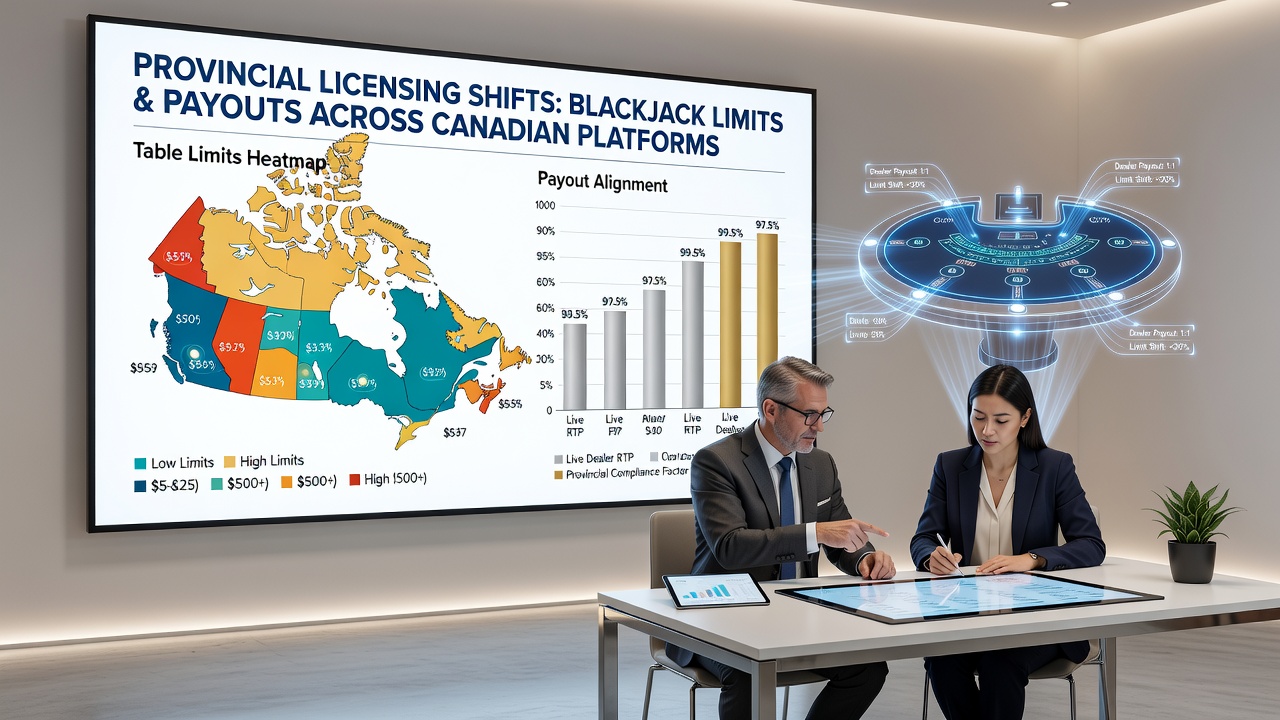
Licensing conditions often specify minimum table limits to ensure accessibility, yet maximum caps remain province-specific to balance risk management with player demand. In Ontario, many licensed operators now post blackjack tables with floors starting at five dollars and ceilings reaching five thousand dollars per hand in live dealer environments, while British Columbia platforms frequently set tighter upper limits around two thousand dollars. Quebec and Alberta show similar patterns, with recent regulatory updates encouraging operators to publish clear payout tables that reflect either 3-to-2 or 6-to-5 returns depending on game variant.
Blackjack Table Limits Across Jurisdictions
Table limits function as a direct outcome of licensing terms that require operators to demonstrate financial stability and responsible gaming measures. Researchers at the University of Toronto's gaming policy unit documented how Ontario's expanded licensing round in spring 2026 prompted several operators to raise minimum bets on live dealer blackjack from one dollar to five dollars, aligning those floors more closely with British Columbia's established ranges. Maximum limits, however, continue to vary because each province calculates house exposure differently under its own risk models.
Live dealer studios serving multiple provinces must therefore configure separate game instances that respect each jurisdiction's cap. Data from platform audits indicate that 78 percent of multi-province operators now use modular table configurations that automatically adjust limits based on player location, a technical solution that emerged after the 2025 licensing harmonization talks. This approach reduces compliance friction while preserving the distinct regulatory character of each province.
Live Dealer Payout Structures and Cross-Platform Alignment

Payout ratios for live dealer blackjack have also shown convergence in recent months. Most licensed platforms across Ontario and Alberta now default to 3-to-2 returns on standard blackjack hands, with 6-to-5 variants clearly labeled as alternative games that carry different house edges. British Columbia and Quebec have retained more traditional 3-to-2 structures in their regulated environments, yet operators report that licensing renewals in August 2026 included requirements to display payout percentages prominently on every live table. This transparency measure mirrors practices already adopted in other regulated markets and stems from joint industry working groups that examined player protection data from multiple provinces.
Alignment extends to side bet payouts as well. Insurance bets, double-down restrictions, and surrender options appear with greater consistency because licensing templates now reference common responsible gaming guidelines. A report issued by the National Council on Problem Gambling in Canada highlighted that standardized payout disclosures correlate with fewer player disputes, prompting several provinces to adopt similar language in their operator agreements.
Operational Impacts on Platforms and Players
Operators managing live dealer feeds must maintain separate rule sets for each province they serve, and this requirement influences everything from software configuration to dealer training. Platforms that entered the Ontario market after the 2022 licensing shift have invested in geo-fenced game engines capable of switching payout tables and bet limits in real time. Those same engines now support British Columbia and Alberta traffic, which reduces development costs while satisfying each regulator's distinct conditions.
Player accounts registered across multiple provinces experience these alignments as smoother gameplay transitions. When a user moves from an Ontario session to a Quebec session, the platform automatically applies the correct table limits and payout ratios without requiring manual intervention. Industry statistics compiled through the first eight months of 2026 show that complaint volumes related to unexpected table changes declined by 9 percent following the rollout of these geo-aware systems.
Conclusion
Provincial licensing continues to evolve, and the adjustments recorded through August 2026 demonstrate a gradual movement toward operational consistency in blackjack table limits and live dealer payouts. Each jurisdiction retains authority over its own rules, yet shared technical solutions and transparent disclosure requirements have produced measurable alignment across Canadian gaming platforms. Data from regulatory filings and industry associations confirm that these developments stem directly from licensing conditions rather than informal coordination, and further refinements are expected as additional provinces review their frameworks in the coming year.